The Geopolitical Kill Switch: AI Supply Chains and Sovereign Risks
Borders are not just lines on a map, they are a reflection of power dynamics. — Robert D. Kaplan
It wasn’t that long ago that Anthropic was running its public “Project Vend” experiments, using its best-in-class models to operate a workspace vending machine (see Anthropic Project Vend Phase 1 and Phase 2). The results were amusing, if humbling: the systems simply weren’t that smart yet, often stumbling over the basic mechanics of inventory and user intent. We all knew the technology was moving at a staggering velocity, but amid the relentless industry hype, it was easy to wonder how much of the frontier marketing was genuine capability and how much was breathless salesmanship.
Then came this week. I opened Claude Code to find Fable 5 quietly waiting for me, accompanied by a stark warning that it would burn through my token allocation twice as fast as Opus 4.8. Worse, an artificial indicator of urgency informed me I only had until 22 June to test it in this mode, and as practitioners, we are always inherently suspicious of manufactured urgency indicators. I hesitated. For my day-to-day engineering and data science pipelines, Sonnet and Opus were executing beautifully; throwing an expensive experimental model at standard codebases felt like a waste of resources.
I never got the chance to find out if it was worth the premium.
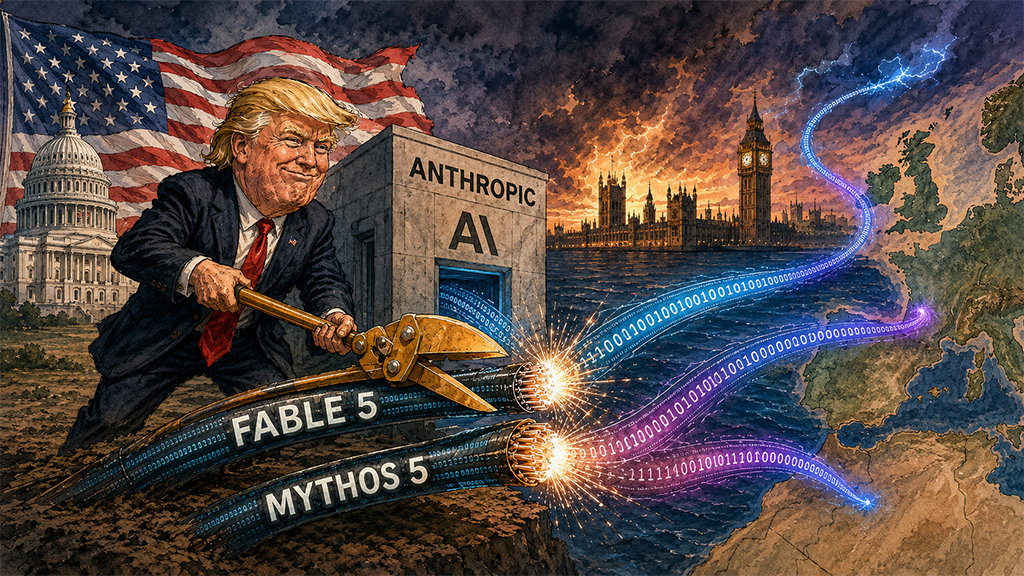
In a staggering escalation of state intervention, the US Government has ordered Anthropic to deny access to Fable 5 and Mythos 5 to all foreign nationals, effective immediately (announced in Anthropic’s official news brief). This sweeping blockade applies to users both inside and outside the United States, and extends to Anthropic’s own non-American workforce. Citing acute National Security concerns, Washington didn’t just tweak an export control guideline; they pulled the digital plug.
The Supply Chain Risk Reversals
This is the explosive culmination of a bitter, months-long feud between the Trump Administration and the safety-focused AI lab. When the Pentagon and Secretary of Defense Pete Hegseth instructed Anthropic to strip away its foundational safety and security guardrails from Claude, the company made a defiant stand, stating they could not “in good conscience accede to their request” (reported by The Guardian). Hegseth promptly retaliated, declaring Anthropic an explicit “supply chain risk” - the first time a domestic company has ever received that designation; sparking a federal lawsuit as Anthropic sues the US government.
The irony is palpable. Anthropic was branded a supply chain risk by its own state for trying to maintain global safety standards. Yet, for those of us operating outside the United States, the true supply chain risk turned out to be the volatile shifting of the geopolitical landscape itself.
For years, tech leaders and enterprise architects have operated under a comfortable, capitalistic illusion. We assumed that our digital supply lines were stable, bounded only by data residency laws, GDP, and typical corporate SLAs. We relied on market capitalism to keep providers honest: if a dominant tech company misused our data or suffered catastrophic downtime, the reputational damage would simply cause us to pivot to a competitor. There was no single monopoly, open-source models offered a brilliant baseline safety net, and the playing field felt universally accessible.
| The Infrastructure Illusion | The Sovereign Reality |
|---|---|
| Vendor Interoperability: If Provider A drops, we swap to Provider B with minimal friction. | Geopolitical Lockout: A single executive order can instantly sever access to tier-1 intelligence based on nationality. |
| Market Capitalism: Reputational damage and competition keep big tech honest and universally accessible. | National Security Hegemony: State directives completely override corporate revenue, market reputation, and global customer trust. |
| Sovereign Data Residency: As long as our data stays within regional borders (UK/EU), our pipelines are secure. | Corporate Sovereignty: If the corporate headquarters reside under a restricting jurisdiction, regional servers offer zero protection. |
The Myth of European Hosting
The most alarming aspect of this week’s directive is how completely it dismantles traditional enterprise risk frameworks. For the past few years, European and British compliance officers have felt insulated by opting for regional data residency—pinning their API connections to cloud endpoints physically hosted within the EU.
This embargo shatters that comfort zone. Because Anthropic is a US-incorporated entity, Washington’s order functions as an absolute export restriction. It does not matter if the model weights are being served out of a data centre in Frankfurt or Dublin; if the parent company is ordered to enforce a blockade on foreign nationals, the switch is flipped at the corporate level. Compute residency is completely subordinate to political jurisdiction.
The DeepSeek Parallel
This isn’t our first brush with geopolitical anxiety. When DeepSeek first broke into the mainstream, a wave of data residency and security panics swept through western compliance teams. The immediate reaction from many risk officers was to flag or completely block the API due to concerns over foreign state data surveillance.
However, the saving grace of that era was the open nature of the ecosystem. If you didn’t trust the foreign API, you could simply pull down the open weights and “roll your own” on secure, ring-fenced infrastructure. It highlighted a critical truth that we have quickly forgotten: Data residency is entirely meaningless if you do not control the runtime environment.
This realisation, that ownership of the runtime is the only true hedge against geopolitical volatility, is the starting point for any resilient AI strategy.
Architecting for a Fractured World
Amateurs study tactics; professionals study logistics.
What does this mean for businesses that have built entire operational workflows around foreign-hosted AI APIs? If the APIs your infrastructure is built upon can vanish at the whim of a foreign executive order, you aren’t just exposed to standard downtime—you are exposed to an economic embargo.
If we are to survive this architectural shift, technical leadership must actively diversify how they orchestrate and access their foundational models:
1. Regional API Diversification
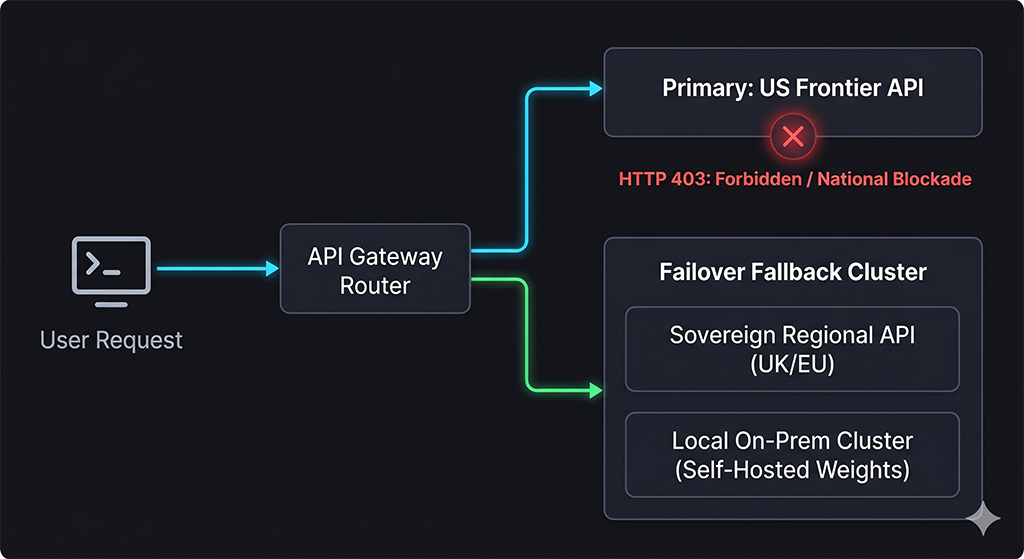
Relying entirely on a single geopolitical region for your foundational intelligence is an architectural single point of failure. Just as we design multi-cloud deployments for high availability, we must now design geographically redundant model routing. If your primary system relies on US-backed frontier models, your secondary hot-failover must pull from sovereign alternatives hosted in entirely independent jurisdictions.
2. The Self-Hosting Bottleneck: The Local GPU Reality
This brings us to the ultimate fallback: getting comfortable with self-hosting open-source models on our own infrastructure. If you own the weights and run them on your own local silicon, no foreign court order can take them away from you.
But this path introduces a brutal, physical contradiction: the global GPU scarcity.
It is easy to write a disaster recovery policy that states “we will failover to local open-source weights if our primary APIs are cut off.” It is significantly harder to execute that policy when the entire world is fighting over the same limited allocation of local cloud compute and physical silicon. If your organisation does not already possess the infrastructure, containerised deployment patterns, and internal engineering competence to spin up large-scale local weights under load, your backup plan is nothing more than a paper exercise.
Are the Halcyon Days Over?
We are rapidly heading towards a multi-tier digital citizenship. The level of intelligence your software can leverage is no longer just a question of what your engineering budget can afford; it is dictated by the passport your employees hold and the soil your servers sit on.
But the final, terrifying frontier of this paradigm shift isn’t just about API access or cloud hosting. If state actors are now comfortable declaring private software labs a supply chain risk, we must confront the logical end-game of this nationalist decoupling. What happens if a future government takes the final step and bans computer scientists from releasing and sharing open-source weights altogether?
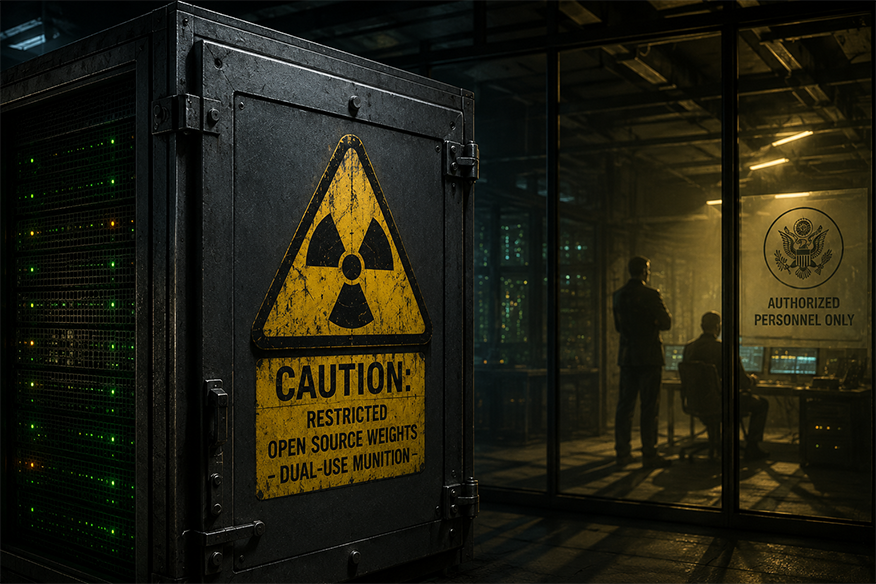
While we currently enjoy the freedom to download and self-host open models, there is no structural guarantee that this freedom will endure. If tomorrow’s frontier architectures are arbitrarily reclassified as dual-use weapons, we may find ourselves in an era where AI weights are legally treated like digital nuclear materials, guarded by state non-proliferation treaties, locked behind sovereign checkpoints, and completely severed from the global open-source community that built them.
The Path Forward: Asking the Right Questions
The scenario above is bleak, but it is a call to action. As technical leaders, we can no longer afford to treat AI models as simple utilities—like electricity or water—that will always be available. We must start critically assessing the “digital supply chains” we are embedding into the core of our businesses.
The question is no longer just about redundancy, but about sovereignty. We need to engage with our national governments to determine what a real strategy for the AI era looks like. Does there need to be a national AI infrastructure plan? How do we protect our businesses and our customers from an over-dependency on third-party systems that we now know are subject to the whims of foreign political volatility?
We don’t have all the answers yet, but the first step toward resilience is refusing to ignore the risk. It is time to move beyond the illusion of stability and start building for a world where the only true security is the one we architect ourselves.
Enjoyed this post?
Share it with your colleagues, network, or friends: